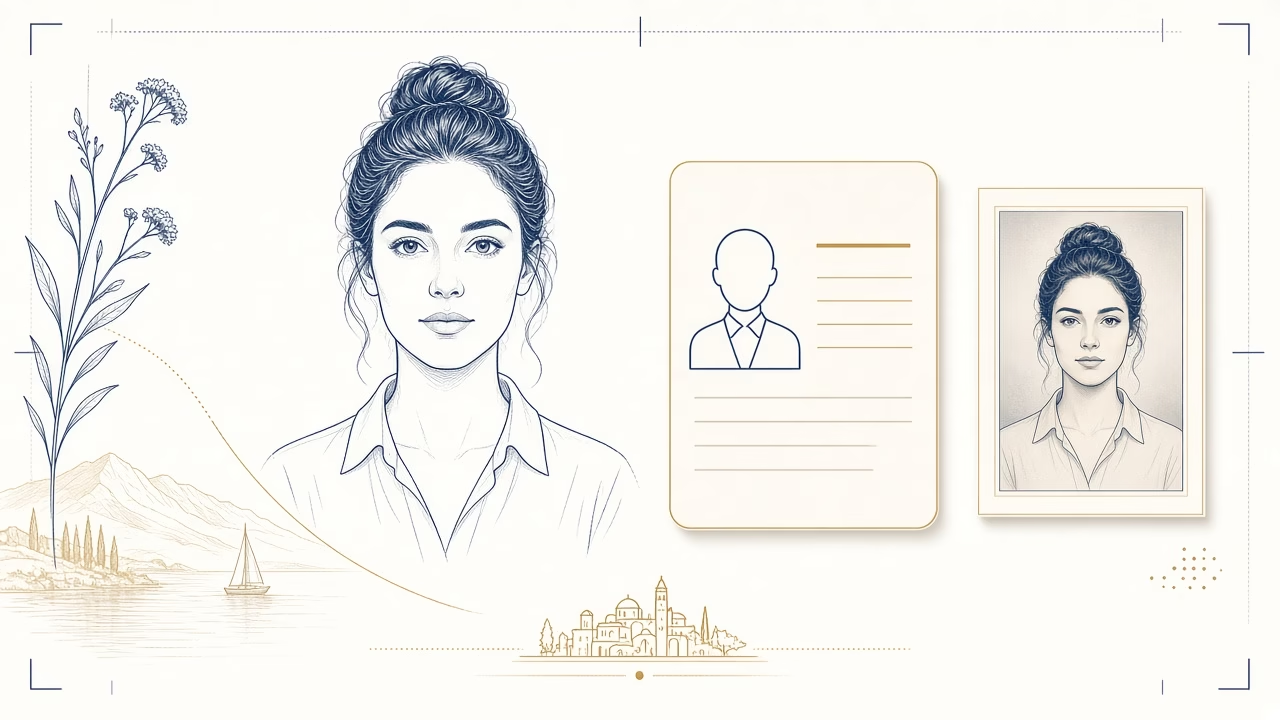
The phrase “ID photo” is routinely used for several different products. It may mean the image for the new Greek police identity card, but it can also describe a small print intended for a school card, club, employee file or private form. These uses do not automatically share the same process or technical rules. The useful question is not simply “which size do I need?”, but “which organisation will use this photograph, and how will it receive it?”
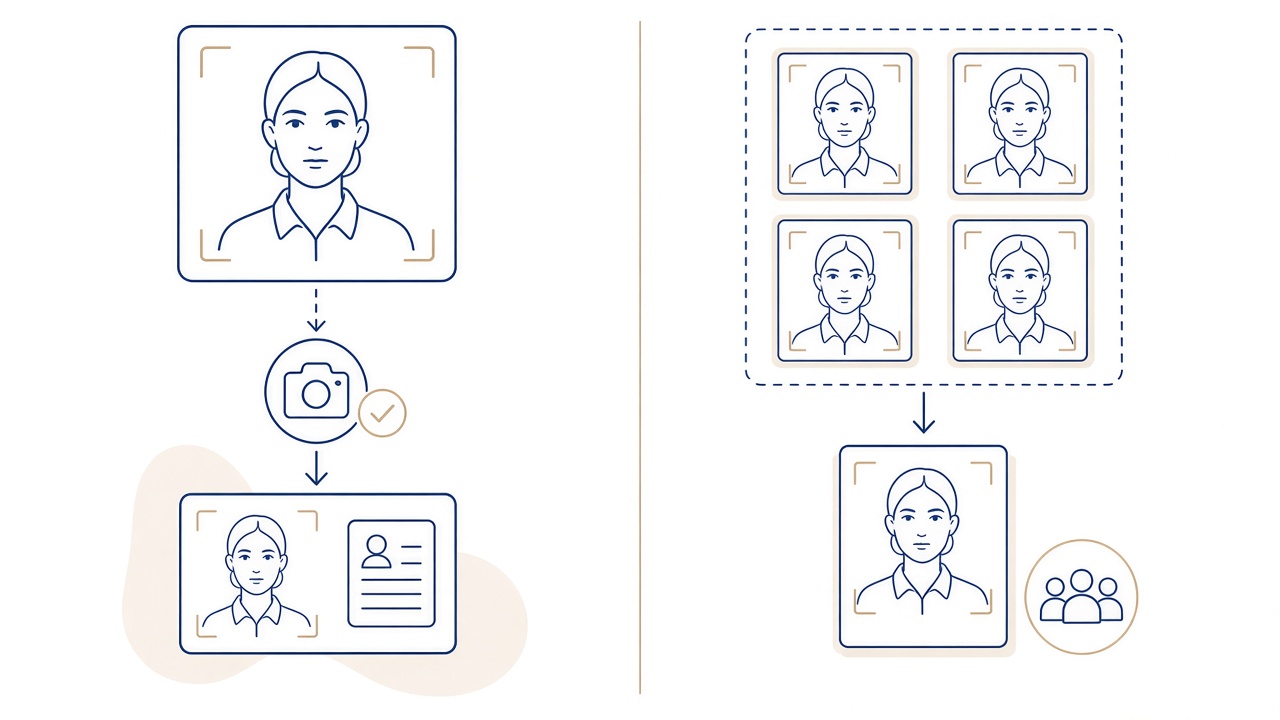
For the new Greek police identity card, the current official process calls for one recent digital photograph following ICAO 9303. It can be submitted through myPhoto or captured by the competent police authority. No arbitrary print size should be attributed to the new card. By contrast, ordinary 3.5 × 4.5 cm “identity-style” prints are commonly requested for some school, company or other uses, but only where the particular recipient specifies them.
The new Greek police identity card
If you are applying for the new card, begin with the official process entry. It sets out the current supporting documents and photographic options. Under the myPhoto route, an authorised photographer takes the photograph and submits the digital image. You receive the relevant code and complete the association steps. Alternatively, the photograph may be captured at the police authority, subject to its arrangements and instructions.
The digital image must be recent and provide a faithful likeness. ICAO principles require a frontal pose, steady head position, natural expression and clear view of the essential facial features. Lighting should control shadows and reflections, while background and composition are handled as part of the professional capture. Personal aesthetic preferences come after accurate identification and technical compliance.
Why “four ID photos” is not a complete order
Older terminology remains in everyday speech, but it can produce the wrong product. Before your session, say precisely whether the photograph is for a new Greek police identity card, school card, employment application, membership card or another document. If you have a form, email or link containing specifications, bring it. The photographer can then establish whether you need myPhoto, a digital file with prescribed properties or physical prints.
Prints measuring 3.5 × 4.5 cm are often described as identity-style photographs and remain common in several non-police contexts. That does not mean every school, employer or organisation wants that size. Some recipients require a different crop, quantity or digital file. Their written instruction takes precedence over custom, and a verbal request passed through several people may omit an important detail.
Preparing for the capture
Choose a simple top that remains distinct from the background. Bulky accessories, tinted lenses and reflections in spectacles can obscure features. Hair should leave the face clearly visible, without requiring you to abandon your ordinary appearance. Avoid excessive shine on the skin and arrive looking much as you do from day to day. Keep a calm, natural expression and look directly into the camera.
For a child or baby, choose a time when they are rested. Toys, dummies and a companion’s hands must not enter an official image. A simple school photograph may allow more relaxed aesthetic choices, but those depend on its purpose. Do not assume that an attractive souvenir portrait is automatically suitable for an identity document, or that a formal identity image will meet an unrelated school’s crop.
myPhoto, the code and what follows
With myPhoto, delivery is a digital cycle rather than a packet of prints. After upload, you receive a code and follow the instructions for associating the image with your details. Keep it safe, ensure you have understood the next steps and do not share it publicly. Our detailed myPhoto guide explains the general workflow in English.
Possessing a code does not replace your appointment or any other identity-card documents. Nor is it a promise of acceptance. The police authority assesses the application and retains final responsibility. If you have a medical condition, wear a head covering for religious reasons or have another circumstance that affects capture, seek official guidance before your appointment rather than relying on a generic answer.
A quick check before ordering
- Write down the exact name of the document or card.
- Ask whether delivery must be through myPhoto, as a digital file or as prints.
- If prints are requested, confirm dimensions and quantity.
- Bring any sample or official instruction sent by the recipient.
- Check whether there is a deadline or recency requirement.
Common sources of confusion
Dimensions alone never describe a complete photograph. Two images can have the same print size but different head scale, eye position, background or crop. Likewise, a high-resolution file is not automatically correct for an online portal if its pixel dimensions, file format or compression do not match the recipient’s rules. Ask for the full specification and avoid resizing or filtering the delivered image yourself.
Be equally careful with the words “passport size”. They are not an international unit of measurement, and using them for a school or business card can create uncertainty. Name the country and document whenever one is involved. Where the use is purely internal, ask the organisation for a sample or written dimensions before visiting the studio.
Frequently asked questions
Does the new Greek identity card require a 3.5 × 4.5 cm print?
Not as a general rule. The official process uses a recent ICAO digital photograph through myPhoto or a capture made by the police authority.
Can the police take my photograph?
Yes. The official process lists capture by the competent police authority as an option. Confirm the practical arrangements for your appointment.
Where is the 3.5 × 4.5 cm size commonly used?
It is common for certain school cards and other private or administrative purposes, but only when the recipient asks for it.
Are all identity-style photographs the same size?
No. Size, crop and delivery method depend on the organisation and the precise purpose.
What should I bring if I have received a sample?
Bring the entire form, email or link so details beyond dimensions can also be checked.
Should I retain my myPhoto code?
Yes. Store it safely and follow the association and use instructions applicable to your process.
Is strong retouching permitted?
Not for an official identity card. The image must remain faithful and identifying features must not be altered.
What about spectacles?
The eyes need to remain visible without glare or shadow. Discuss removing spectacles during capture if they cause an obstruction.
Does the code guarantee issue of the card?
No. It refers to the digital image; final acceptance is a matter for the competent police authority.
Can one capture be used for every card?
Not necessarily. Each organisation may set a different size, background, recency period or file format.
Choose the correct ID photograph in Volos
Tell us the exact document you need. Panorama Studio, serving Volos since 1989 and authorised for myPhoto, can help identify the appropriate delivery route. Contact us and bring the recipient’s instructions. Final acceptance always belongs to the issuing authority.