How to choose the best photographs for an album
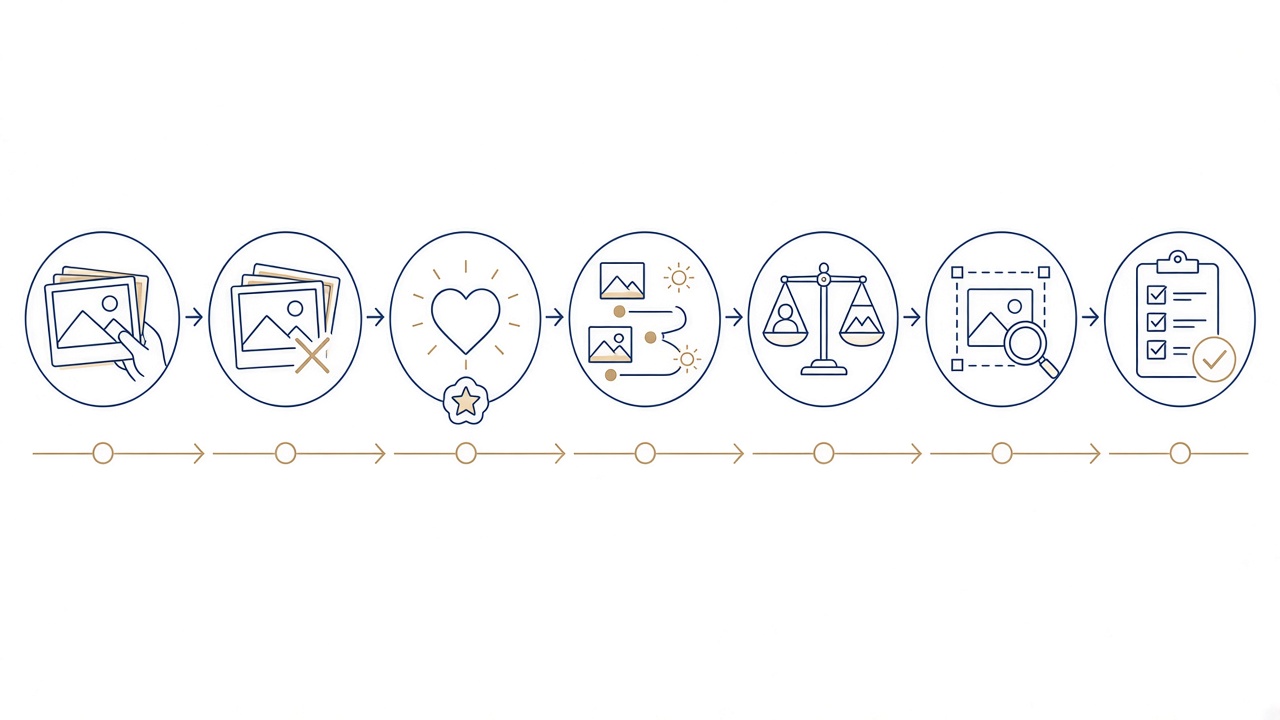
The best photograph for an album is not always the most striking frame in isolation. It is the one that advances the story, adding a person, place, emotion or detail without repeating what has already been said. A staged selection process makes the task clearer and guards against rushed decisions.
Define the story
Write one sentence describing what the album is about and who will view it. This criterion helps remove attractive pictures that belong to a different narrative.
Make a broad first selection
Gather candidates before designing pages. Divide them into key moments so that gaps, missing people and areas of excessive emphasis become visible early.
Remove near-duplicates
Within a sequence, keep the frame with the clearest expression, composition and focus. Retain another only when it supplies different information or changes the emotional pace.
Balance people and details
Combine portraits, groups, wide scenes and small details. Check that important people are represented fairly, using judgement rather than turning the process into a mechanical count.
Use chronology as a foundation
Time order is easy to understand, but it can be divided into chapters or themes. Mark changes in place and time through an image, heading or clear transition.
Build a page rhythm
Alternate quiet pages with few pictures and denser arrangements where appropriate. Give more room to pivotal photographs instead of forcing every image to the same size.
Check resolution and cropping
Use the best available file and take quality warnings seriously. Inspect every frame for awkward cropping near faces, hands, signs and details required by the story.
Invite input and proof carefully
Family members can correct names, dates and omissions. Before ordering, review every spread in sequence, then check the cover, captions, spelling and first and final pages again.
For more detail, read the related Photo Panorama guide. You can lay out your selection as a photobook.
A method from an oversized folder to the final proof
Do not begin with a compulsory picture count. List the chapters the story needs, then make a broad selection for each. Only after seeing the available material should you relate the number of photographs to the pages. This prevents an essential moment being sacrificed merely to satisfy an arbitrary target.
For every group of near-duplicates, compare expressions, movement, focus and activity in the background. Mark one as the principal choice and retain a second only if it changes the information. Two frames may earn a place when different people in a group are visible, not when they differ only by an instant.
Chronology is a useful framework but need not become a restriction. A journey can follow individual days, a family year can use seasons and a wedding can follow stages of the event. If a thematic diversion clarifies the account, use a heading or transitional image so the reader can follow the change.
Watch page rhythm while arranging the edit. One pivotal photograph may deserve a full page, whereas a sequence of details can work in smaller frames. Avoid giving everything equal visual weight. Changes of scale should reflect meaning and usable quality rather than being applied as random decoration.
Proofing is a different task from selecting. Read headings and captions, check for a missing frame, locate accidental duplicates and inspect every crop close up. Then review the book once more at a normal scale to confirm that its sequence, changes of pace and final page work as one coherent narrative.
Removal is part of the edit
Once the first design is complete, try removing one picture from every crowded page. If the story remains intact and the composition breathes more easily, that frame was probably unnecessary. If its absence creates an informational or emotional gap, restore it. This test is more dependable than a universal numerical rule. Finally, record the files actually used so that the selected original cannot later be confused with a similar copy.
Frequently asked questions
How many photographs should an album contain?
There is no universal count. It depends on pages, subject and intended pace. List the necessary moments first, then reduce the selection until every remaining picture has a clear reason to be present.
How many frames should I retain from one moment?
One strong frame is usually enough. Keep another when the expression changes, a different important person becomes visible or new information appears. A tiny change in camera position does not create a new narrative role.
How do I choose between two nearly identical portraits?
Compare expression, focus on the eyes, movement and background. Then decide which portrait works better beside its neighbouring pages. The choice concerns both the isolated picture and its role within the sequence.
Must the story follow strict chronology?
No, but the order must remain understandable. Chapters may follow place, person or theme, with a heading or transitional picture to signal a change of time.
How can I identify gaps in the story?
Write down the main chapters and place candidate pictures beneath each one. An empty chapter or abrupt transition indicates that another image, a brief caption or a different structure may be needed.
How do I balance people, places and details?
Use wide views to establish location, portraits for human connection and details for atmosphere. Balance should serve the particular event and does not require an equal count in every category.
What if an important photograph has low resolution?
First search for the original or a better copy. If none exists, consider a smaller frame and heed the quality indicator. Do not enlarge it on the assumption that software can invent missing detail.
When should I inspect cropping?
Check during placement and again in the final proof. Watch faces, hands, writing and objects near edges because a change of frame or layout can alter the visible part of the file.
Who should contribute to the final edit?
People who know the story can correct names, dates and significant omissions. Give one person responsibility for the consistent final decision, however, so personal preferences do not produce endless competing versions.
What belongs in a proper final proof?
Review every page in order, then inspect each spread close up. Search for duplicates, empty frames, wording errors, awkward crops, resolution warnings and breaks in continuity between the cover, opening and ending.
Your next step
Upload your final selection to Online Photobook and check every page before ordering.