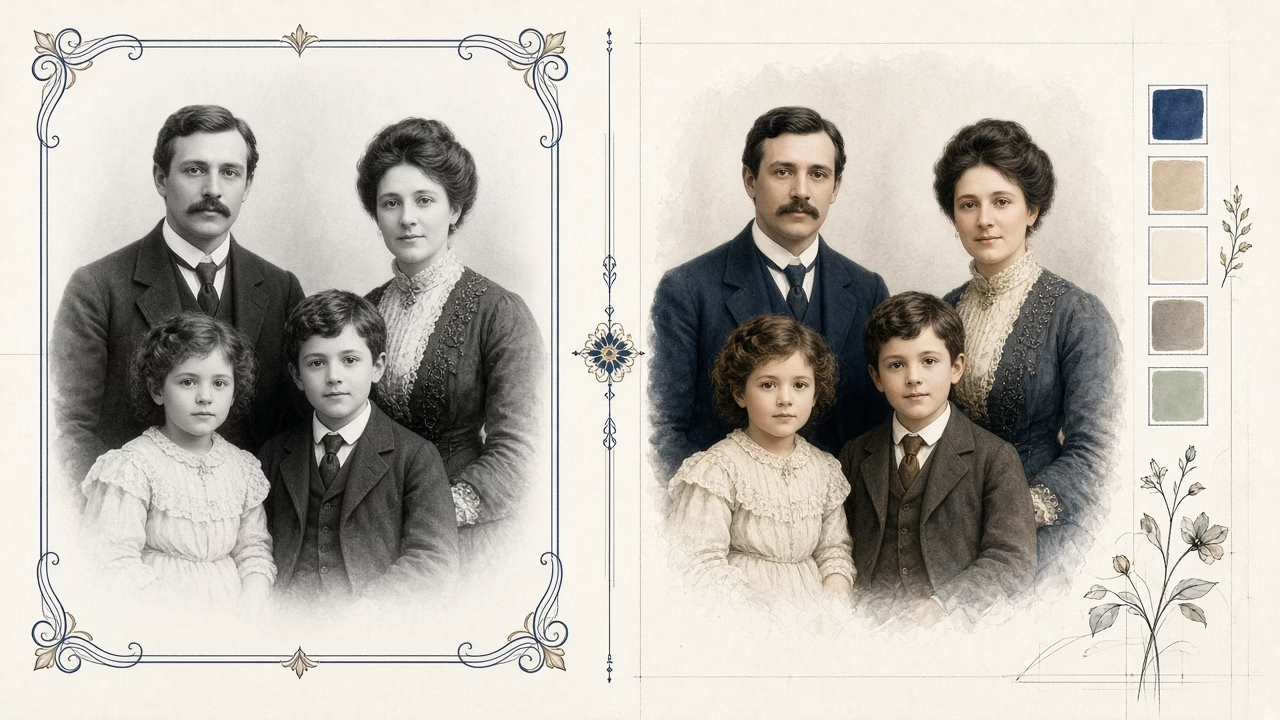
Colourisation offers one plausible colour reading of a black and white photograph. It is not proof of the historical colours. Panorama Studio in Volos, established in 1989, bases the work on available references, restrained choices and clear approval.
If the finished version is to be printed, experience from the professional Fujifilm photo laboratory informs the choice of size and paper. The monochrome master is always retained separately from the colour interpretation.
Assessment and restoration
Work begins from a clean monochrome master with the best practical resolution and tonal range. Tears, stains or losses are assessed as a separate restoration stage. Reconstructing damage and choosing a colour are different decisions.
Useful references
Family notes, colour photographs from the period, known uniforms and surviving objects can reduce uncertainty. Photographs of relatives may inform eyes or hair without providing absolute proof. Areas lacking evidence are acknowledged as interpretive.
Skin, clothing and background
Skin tones follow the original light and shade rather than covering a face with one flat colour. Clothing receives a restrained palette when evidence is missing. Background colour supports the subject without excessive saturation that changes the character of the photograph.
Proof and approval
A proof allows specific comments on faces, clothing, objects and background. Agreed revisions are made before the final file is approved. A major change of direction after approval may need a fresh estimate of cost and time.
Files and prints
The monochrome master and approved colour version are supplied as separate files at the agreed resolution and format. Printing is chosen after file approval. Timing depends on condition, research, restoration, revisions, output size and quantity.
Recording assumptions
Decisions about uncertain hues are recorded with the references used. The customer can then distinguish evidence-based areas from aesthetic choices. This transparency is particularly important for family archives, historical displays and photographs containing uniforms or recognisable objects.
Frequently asked questions
Are the added colours historically proven?
No. Where reliable references do not exist, hues are informed or aesthetic assumptions and must be presented as interpretation rather than historical fact.
Which references are useful?
Family notes, colour photographs from the period, known uniforms, surviving objects and reliable historical sources can reduce uncertainty.
How are skin tones handled?
With subtle variation across the face while respecting the original light and shade. One flat tone over all skin produces an artificial result.
Can clothing be coloured without evidence?
They can, but the choice remains an assumption. A restrained palette should be agreed and areas without evidence should be documented.
Is restoration included automatically?
Not automatically. Repairing tears, stains or missing areas is a separate stage that may be undertaken first if it is needed and approved.
Why retain a black and white master?
It is the neutral digital foundation and retains the original tonal information. Future work can then begin without depending on the colour interpretation.
Can I approve a proof first?
Yes. A proof allows skin, clothing, background and overall saturation to be reviewed before the final file is approved.
Can changes be requested after review?
Yes, when comments are specific and concern agreed areas. A major change of direction after approval may need a revised estimate.
Will I receive a digital file?
Yes, at the agreed resolution and format. The monochrome master and approved colour version are supplied as clearly distinct files.
May I order a print as well?
Yes. Printing is chosen after file approval so that size, paper and any border can be decided correctly without premature commitments.
Assessment: Colourising black and white photographs
Send the file or photographs of the source, together with dimensions, quantity, intended use and preferred deadline, through the contact page. The assessment of “Colourising black and white photographs” will cover suitable options and a realistic completion estimate.